











There is a growing number of motorists who would happily embrace electric driving but remain reluctant to give up the reassurance of a petrol engine. Whether it’s concerns about charging infrastructure, longer journeys or simply the prospect of changing familiar habits, the transition to fully electric motoring isn’t necessarily straightforward for everyone. XPENG believes it has an answer with its new L03 PowerX, a range-extended electric vehicle (REEV) that promises the driving characteristics of a battery-electric car with the additional reassurance of an onboard petrol generator. Having spent four hours putting it through its paces on the roads around Cascais in Portugal, I came away thinking this could be one of the most interesting newcomers to the Irish market.
Unlike a conventional plug-in hybrid, where the petrol engine can drive the wheels directly, the L03 REEV uses a compact 1.5-litre petrol engine purely to generate electricity. The wheels are driven electrically, meaning the driving experience remains remarkably consistent regardless of whether the petrol engine is operating. It’s an arrangement that makes considerable sense, particularly for drivers who enjoy the smoothness and immediate response of an electric vehicle but want the reassurance of being able to refuel when necessary. What impressed me most was just how seamlessly the system operates. Throughout our four-hour test drive, the petrol engine would start and stop without us really noticing. There was none of the sudden increase in engine noise that can accompany hard acceleration in some conventional hybrid and plug-in hybrid vehicles. Anyone who has driven certain systems will know the sensation, where the engine revs climb dramatically without a corresponding increase in road speed. It can feel rather like a slipping clutch in an old manual car! Thankfully, there was none of that unpleasant sensation in the XPENG. Instead, the L03 maintained the smooth, quiet character of an electric vehicle throughout our drive.
Perhaps one of the L03 PowerX’s biggest selling points, however, is its impressive electric-only driving range. Thanks to a substantial 37.2kWh battery, XPENG claims it can travel up to 215km on electric power alone under WLTP testing conditions. That’s enough to cover the daily driving requirements of most Irish motorists several times over without using a drop of petrol. When longer journeys beckon, the onboard petrol generator extends the combined driving range to an impressive 1,017km. Better still, the battery supports DC charging at up to 123kW, allowing a 10 to 80 per cent charge in approximately 20 minutes. It’s a particularly appealing combination, offering genuine electric motoring for everyday journeys without the need to plan longer trips around charging stops.
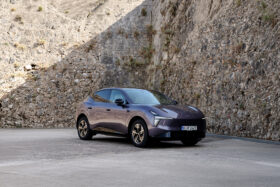
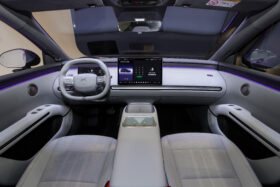
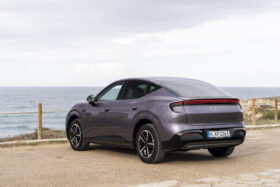
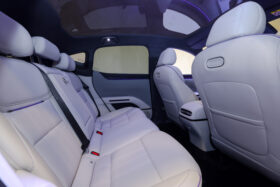
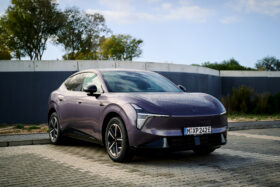
Visually, the L03 makes a strong first impression. Developed under the direction of former Ferrari exterior design chief JuanMa Lopez, it features a wide stance, flowing roofline, frameless doors and distinctive fastback styling. There’s a pleasing balance between sporting design and everyday practicality, while its aerodynamic drag coefficient of just 0.228 demonstrates the attention paid to efficiency. It looks modern without being unnecessarily complicated, and there’s certainly enough visual appeal to attract buyers who might otherwise gravitate towards more established European brands. Inside, the cabin continues XPENG’s emphasis on technology and comfort. A large 15.6-inch central touchscreen dominates the dashboard, complemented by a head-up display, ambient lighting and a particularly comfortable seating arrangement. There’s a real sense of quality throughout, with generous accommodation and no shortage of practical storage. XPENG claims 37 individual storage spaces, while a towing capacity of up to 1,500kg should broaden its appeal to families and those with active lifestyles.
Our driving route around Cascais provided a thoroughly enjoyable mixture of coastal roads, motorway stretches and twisting mountain sections, giving us an excellent opportunity to assess the L03 in a variety of conditions. Much like the larger G9L we also drove during our visit, the first thing that strikes you is the remarkable silence within the cabin. The refinement is genuinely impressive, with little road or wind noise disturbing what is an exceptionally relaxing driving environment. The ride quality was equally convincing. Even when pushing on through some of the more demanding bends, the L03 remained composed and comfortable, displaying a level of body control that inspires confidence. It’s not pretending to be a sports SUV, but there’s more than enough ability here to make an enthusiastic drive enjoyable. Equally importantly, it settles beautifully into a relaxed rhythm when cruising, which is exactly what most owners will appreciate during everyday use.
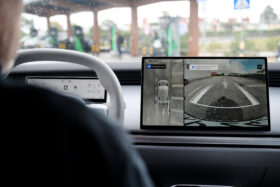
There was one area that proved slightly frustrating. On some of the narrower streets, the lane-keeping assistance became rather intrusive, occasionally tugging at the steering wheel as the system attempted to interpret the road markings and lane positioning. It’s something we’ve encountered in other modern vehicles, particularly on unfamiliar European roads. Thankfully, a quick visit to the vehicle settings allowed us to switch off the assistance and continue without interruption. It’s a relatively minor criticism, although one worth mentioning. As you’d expect from XPENG, the L03 is packed with technology. Its latest XOS 6 operating system introduces an enhanced intelligent cockpit, while integrated Google Maps navigation should make the experience particularly familiar to European customers. There’s also sophisticated voice control and the promise of further functionality through over-the-air updates. XPENG’s next-generation driver assistance technology is planned for a phased European introduction from 2027, subject to regulatory approval.
The L03 will also be available as a fully battery-electric vehicle, giving buyers a choice between conventional electric motoring and the added flexibility of the PowerX range-extender system. For those who aren’t yet comfortable relying entirely on public charging infrastructure, the latter could prove particularly appealing. The L03 PowerX will enter a competitive market, with the Volkswagen Tiguan eHybrid, Toyota RAV4 Plug-in Hybrid and BYD Seal U DM-i all offering alternatives to conventional petrol and diesel motoring. The difference is that the XPENG’s petrol engine acts purely as a generator, rather than providing mechanical drive to the wheels. This allows it to retain that consistent electric driving character even when the engine is running. The Tiguan offers an established European alternative, with its 204hp plug-in hybrid powertrain and electric driving range of approximately 120km, while Toyota’s latest RAV4 PHEV promises up to 137km of electric range in certain configurations. The BYD Seal U DM-i is another particularly relevant competitor, offering a combination of electric driving and petrol-assisted longer-distance capability.
After four hours behind the wheel, I was genuinely impressed by the XPENG L03 PowerX. It delivers the silence, comfort and smooth acceleration that make electric vehicles so enjoyable, while removing much of the uncertainty that still concerns some prospective buyers. The petrol generator operates so unobtrusively that it’s easy to forget it’s there, and that, for me, is the real achievement. Add an attractive design, an impressive cabin and excellent onboard technology, and there’s a very convincing package here. The slightly overenthusiastic lane-keeping assistance was our only notable frustration, but it did little to spoil an otherwise excellent driving experience. For Irish motorists who like the idea of electric driving but aren’t quite ready to commit to a full BEV, the L03 PowerX could be the perfect stepping stone. It’s certainly one I’d encourage them to experience before making their next purchase.