









Irish motorists have always had a soft spot for the Renault Clio. Since arriving in 1990, it has consistently reinvented itself while holding onto the qualities that made it one of Ireland’s favourite small cars. Each generation has brought something genuinely new. The original Clio proved that a compact hatchback could offer the comfort and refinement of something bigger. Clio II doubled down on comfort with its cocoon-like cabin, while Clio III pushed perceived quality to new heights and introduced technology that felt ahead of its time. Clio IV changed the game again with its flowing, modern design, and Clio V embraced the digital era with a large central screen and a more connected interior. Over the years the engine line-up has also played a key role in its popularity, from the famously efficient 1.5 dCi diesel which, ran on the smell of an oily rag to the more recent E-Tech hybrid that quickly became a major seller across Europe. With nearly 17 million sold globally, the Clio remains the best-selling French car of all time and a familiar sight on Irish roads.
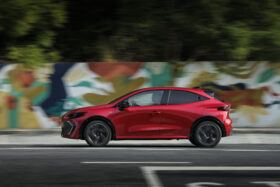
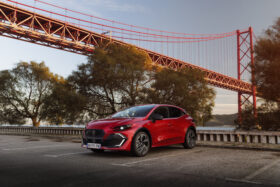
Now it’s time for the sixth-generation Clio to try continue this legacy of reinvention with a design departure few expected. A longer bonnet, extended wheelbase and wider track shift its overall stance closer to that of a compact coupé than a traditional hatchback. A sloping roofline, integrated spoiler and shark-fin antenna give it a sleek profile, while a new grille featuring diamond motifs and a distinctive lighting signature frames the redesigned Renault badge. At the rear, four sculpted taillights inspired by supercar styling contribute to a more beefy appearance. New colours such as Absolute Red and Absolute Green sit alongside familiar favourites including Glacier White, Iron Blue and Shadow Grey.

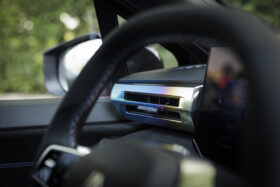
Inside, the transformation is just as radical. Taking influence from the latest Renault models, including the Megane and the Renault 4 and 5, the dashboard has been redesigned using higher quality materials and recycled fabrics. Ambient lighting options add a more modern feel, and depending on the trim level, Alcantara upholstery and coloured chrome accents lift the overall cabin experience. In front of the driver, dual 10.1-inch screens tilt slightly toward the pilot and feature Google built-in, providing sharp graphics and seamless access to Google Maps, Assistant and the Play Store. Wireless Apple CarPlay and Android Auto come as standard. For those who value audio quality, an optional ten-speaker Harman Kardon system will bring your favourite tunes a new lease of life!
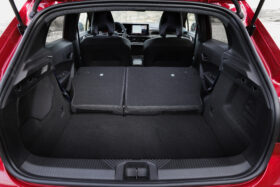
Practicality remains a core part of the Clio’s appeal also. The cabin features smart storage throughout, including a covered central console, multiple USB-C ports, wireless charging and a rear 12V outlet. Boot space is generous at up to 391 litres, helped by a sill that has been lowered by 40 mm to make loading easier. Safety technology has also moved forward, with up to 29 driver assistance features available. These include adaptive cruise control, reverse automatic emergency braking, blind-spot monitoring, lane-keeping assist and a full 360-degree camera system. Renault has introduced systems such as Safety Score and Safety Coach, aimed at helping drivers build safer habits over time. The top-tier Esprit Alpine trim on our test vehicle had a premium feel with Alcantara sports seats, blue detailing, aluminium pedals and unique 18-inch alloys that looked pretty cool.
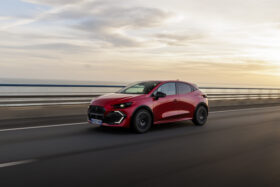
Following a walk-around inspection and a closer look at the cabin’s practicality, it was time to drive the new Clio. The route included a two-and-a-half-hour loop beginning near Lisbon Airport, climbing through twisting mountain passes and returning along a sweeping coastal road via Cascais. Built on the CMF-B platform, the new model benefits from a wider track and a chassis set up for both agility and stability. The improved steering system reduces the number of turns lock-to-lock, giving more precision in tighter bends, while upgraded suspension and sound insulation add a level of refinement usually associated with larger cars.
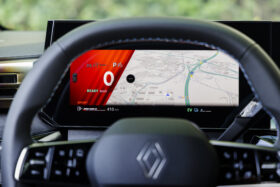
Irish buyers will have two main powertrain choices. The highlight is the full hybrid E-Tech 160, fitted to the test car. This combines a 1.8-litre petrol engine with two electric motors and a 1.4 kWh battery to produce 160 hp. The result is an 8.3-second sprint to 100 km/h and fuel consumption as low as 3.9 l/100 km, with CO₂ emissions of just 89 g/km. If you spend a lot of time driving in Irish cities, the Clio should run on electric power for up to 80 per cent of the time, and on longer journeys it is capable of covering 1,000km on a single tank although our test car was showing 750km. There is also a 115 hp 1.2-litre petrol option, paired either with a manual gearbox or a six-speed dual-clutch automatic with paddle shifters. An LPG dual-fuel Eco-G version may also become available for Irish customers but we believe the chances are faint.
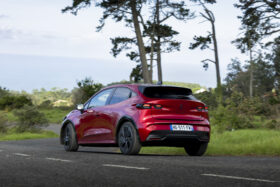
During the test drive, I explored the Multi-Sense driving modes familiar from other Renault models. Alongside the usual Eco, Comfort and Sport settings, the Clio adds a Smart mode designed to analyse driving behaviour and adapt between modes automatically. While this concept should offer flexibility, in practice it felt overly reactive. On inclines, for instance, it frequently switched into Sport mode and dropped too many gears, making the engine noisier and busier than necessary. Switching to manual mode selection resulted in a much more composed experience. Eco and Comfort, in particular, provided smooth transitions between electric and petrol power and none of the hesitation or gear-hunting seen in Smart mode. Overall it was extremely pleasant to cover miles in.
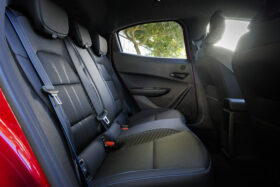
Taken as a whole, the new Clio’s styling, technology and powertrain improvements make it one of the most advanced entries in its segment. It retains the familiar character that has defined the nameplate for decades, yet feels sharper, more contemporary and better equipped to stand out in a crowded marketplace. However, the timing of its arrival may pose a challenge. While left-hand-drive markets can already place orders, right-hand-drive production delays mean Irish customers may not see the new Clio until 2027. Whether buyers will wait that long remains an open question, but what is clear is that Renault has produced a compelling evolution of one of its most loved and important models.